MOA of Sulfonyl Acid Derivatives
Sulfonylureas (Tolbutamide, Chlorpropamide), a class of sulfonyl acid derivatives, have a significant action in lowering blood glucose levels in normal subjects and in type 2 diabetics.
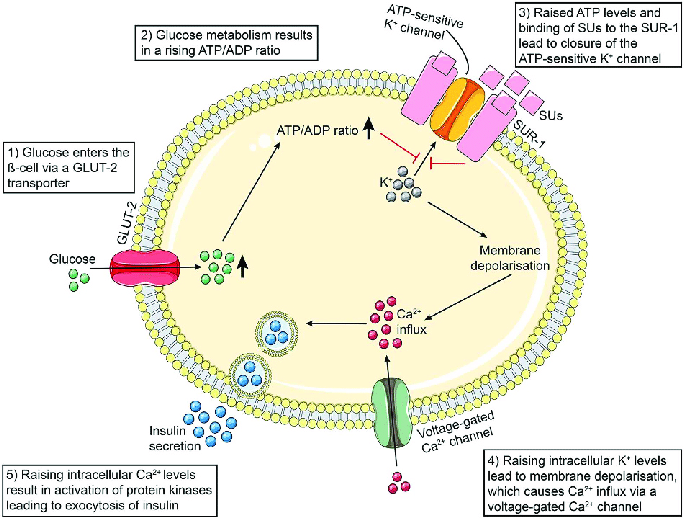
The mechanism of action of sulfonylureas involves provoking a brisk release of insulin from the pancreas.
MOA:
(1) They act on the so-called ‘sulfonylurea receptors’ (SUR1) on the pancreatic β cell membrane.
(2) This action causes depolarization by reducing the conductance of ATP-sensitive K+ channels. (Raised ATP production followed by raised Glucose also reduces the conductance of ATP sensitive K+ Channels)
(3) This process enhances Ca2+ influx (Followed by the stimulation of Voltage sensitive Ca++ Channel) and degranulation (followed by calcium dependent translocation), which increases the rate of insulin secretion.
NOTE: The sulfonylureas primarily augment the 2nd phase insulin secretion with little effect on the 1st phase. That they do not cause hypoglycemia in pancreatectomized animals and in type 1 diabetics (presence of at least 30% functional β cells is essential for their action) confirms their indirect action through the pancreas.


Comments
Post a Comment