CLICK
Posts

MOA of Paracetamol Paracetamol, also known as acetaminophen, is a widely used non-opioid analgesic and antipyretic agent. Despite its widespread use, the exact mechanism of action of paracetamol is not fully understood. However, it is generally believed to work in the following ways: Inhibition of Prostaglandin Synthesis : Paracetamol is thought to produce analgesia (pain relief) through a central inhibition of prostaglandin synthesis. Prostaglandins are produced by the body in response to injury and certain diseases. By reducing the production of prostaglandins in the brain and spinal cord, paracetamol can relieve pain. Inhibition of COX-1 and COX-2 : Paracetamol inhibits the enzymes cyclooxygenase-1 (COX-1) and cyclooxygenase-2 (COX-2), which are involved in the production of prostaglandins. Formation of N-arachidonoylphenolamine : In the brain and spinal cord, paracetamol can combine with arachidonic acid to form N-arachidonoylphenolamine. It’s important to note that thes...
Formulation of Injections: (i) Injectable Solution: A range of excipients are included in parenteral solution like antioxidants, antimicrobial agents, buffer, chelating agent etc. to maintain the stability. Preparation: Dissolve drug (API) & excipient in a vehicle Filter the solution through a membrane filter and pH is adjusted. Preservatives are added (e.g. Methyl/ ethyl paraben) Sterilized in autoclave at 121 degree Celsius. Aseptic filling in a suitable container.

CAPSULES Manufacture of Gelatin Explore The manufacturing process of gelatin involves several main stages: Pretreatments : This step prepares the raw materials for the main extraction step and removes impurities that may negatively affect the physicochemical properties of the final gelatin product. Hydrolysis of Collagen : Collagen, a natural protein present in the tendons, ligaments, and tissues of animals, is hydrolyzed to form gelatin. This process involves boiling the connective tissues, bones, and skins of animals. Extraction : Gelatin is extracted from the hydrolysis mixture. The gelatin can be ground into a fine powder or cut into sheets for use. Freeze drying : Solution is freeze dried and gelatin is prepared. Contents of capsules HARD GELATIN CAPSULE SOFT GELATIN CAPSULE Gelatin Gelatin Water Plasticizer: Glycerine Sulfer Dioxide: Prevents Decomposition Water ...
Other Methods - Various blenders and homogenizer Principle- the homogenizers are based on the principle that the large globules in coarse emulsion are broken in to smaller globules by passing them under pressure through a narrow orifice. A coarse emulsion is prepared in a mortar which is then transferred in to hand homogenizer. The emulsion is passed through a homogenizer many a times till an emulsion of desired satisfaction is produced (a) Hand homogenizer- Hand operated. (b) Silverstone mixer homogenizer
Bottle Method Bottle method is used for the preparation of volatile and non-viscous oils. Procedure The proportion of oil :water : gum is 2:2:1. (a) measure the required quantity of the oil and transfer in to a larger bottle . (b) Add the required quantity of powdered gum acacia. (c) Shake the bottle vigorously until the oil and gum mixed thoroughly. (d) Add the calculated amount of water at once. (e) Shake the mixture vigorously to form a primary emulsion. (f) Add more of water in small portions with constant agitation to produce the required volume.

Wet gum Method Procedure (a) Calculate the quantity oil , water and gum required for preparing the primary emulsion. (b) Powder the gum acacia. (c) Add water and triturate it with gum so as to form a mucilage . (d) Add required quantity of oil in small proportion with rapid trituration until a clicking sound is produced and the product becomes white or nearly white . (e) At this stage the emulsion is as ‘ Primary emulsion’ . (f) Add more of water in small portions to the primary emulsion with trituration to produce the required volume. (g) Stir thoroughly so as to form a uniform emulsion. (h) Transfer the emulsion to a bottle, cork, label and dispense. RATIO of WATER: OIL: GUM

Dry Gum Method This method is often used to make the initial or primary emulsion out of oil, water, and a hydrocolloid or “gum” emulsifier (usually an acacia). PROCEDURE (a) Measure the required quantity of oil in a dry measure and transfer it in to a dry mortar . ( b) Add the calculated quantity of gum acacia in to it and t riturate rapidly so as to form a uniform mixture. (c) Add required quantity of water a nd triturate vigorously till a clicking sound is produced and product becomes white or nearly white . The emulsion produced at this stage is known as ‘ Primary emulsion’ . (d) Add more water to produce required volume The following table shows the proportion of oil , water and gum acacia required:-

MOA of alpha glucosidase inhibitors: Alpha-glucosidase inhibitors are a class of oral anti-diabetic drugs used for diabetes mellitus type 2 EXAMPLE: Acarbose MOA (a) Reduces intestinal absorption of Starch, dextrin and disaccharide by inhibiting the action of alpha-glucosidase in intestinal brush border. (b) Inhibition of the enzyme slows the absorption of carbohydrates . (c) Alpha glucosidase helps in the conversion of Oligosaccharides to monosaccharides which further absorbed and results in rise of postprandial rise in plasma glucose . (d) Inhibition of AG results in no conversion (or less) of Oligosaccharides to monosaccharides . (e) As a result, postprandial rise in plasma glucose is reduced. Picture source: https://www.researchgate.net/figure/Mechanism-of-action-of-alpha-glucosidase-inhibitors_fig2_279991207 Side Effects: GIT problems Liver Problems Hypoglycaemia Allergic Reactions
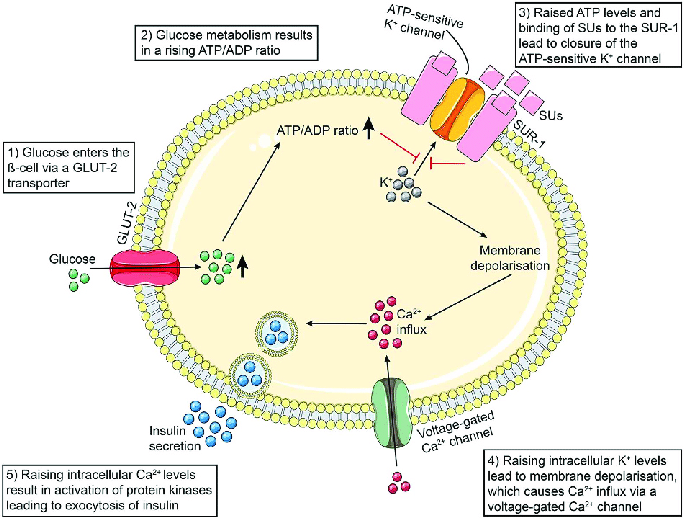
MOA of Sulfonyl Acid Derivatives Sulfonylureas ( Tolbutamide, Chlorpropamide ), a class of sulfonyl acid derivatives, have a significant action in lowering blood glucose levels in normal subjects and in type 2 diabetics . The mechanism of action of sulfonylureas involves provoking a brisk release of insulin from the pancreas. MOA: (1) They act on the so-called ‘sulfonylurea receptors’ (SUR1) on the pancreatic β cell membrane. (2) This action causes depolarization by reducing the conductance of ATP-sensitive K+ channels . (Raised ATP production followed by raised Glucose also reduces the conductance of ATP sensitive K+ Channels) (3) This process enhances Ca2+ influx (Followed by the stimulation of Voltage sensitive Ca++ Channel) and degranulation (followed by calcium dependent translocation), which increases the rate of insulin secretion . Fig - 01 NOTE: The sulfonylureas primarily augment the 2nd phase insulin secretion with little effect on the 1st phase. T...
Why Aspirin is Used in cardiovascular complications? Aspirin is often used in the treatment and prevention of cardiovascular complications due to its blood-thinning properties. Low dose of Aspirin is used for the treatment of various CVS complications including MI and High blood Pressure. Mechanism of Action Aspirin irreversibly acetylate the serine part of both of the COX enzymes (COX-1, and COX-2). Low dose of Aspirin is used to irreversible blocking of TXA2. COXs are responsible for the conversion of AA to PGG2 to PGH2 and then Thromboxane A2 (TXA2) which upon binding to the TP (alpha and beta) receptor results in platelet aggregation. and induces blood clotting phenomenon. For example: Blood clotting in the atherosclerotic plaque results in the development of Angina (unstable). Inhibition of COXs Results decreased production of TXA2 and thus platelet aggregation does not occurs and Anginal condition may be prevented. thus decreased chances ...
Short note on insulin Lispro Insulin Lispro is a rapid-acting form of insulin used for the treatment of hyperglycemia caused by Type 1 and Type 2 Diabetes . It is a short-acting , manmade version of human insulin . MOA: Insulin Lispro works by replacing the insulin that is normally produced by the body (endogenous) and by helping move sugar from the blood into other body tissues where it is used for energy. It also stops the liver from producing more sugar (glycogenolysis). Insulin Lispro starts to work about 15 minutes after taken, peaks in about 1 hour , and keeps working for 2 to 4 hours . Uses': It is used to improve blood sugar control in adults and children with diabetes mellitus. Side Effects : The most common side effect of Insulin Lispro is hypoglycemia (low blood glucose level). Other side effects include weight gain , infusion site reaction , headache, pain, nasopharyngitis (inflammation of the throat and nasal passages), and auto-antibody ...
PARACETAMOL TOXICITY The drug of choice for treating paracetamol (also known as acetaminophen) toxicity is N-acetylcysteine (NAC) (Intravenous) & Methionine (Oral) N-acetylcysteine is given to all patients who have high paracetamol level. If there is any doubt about the time of the overdose or if there has been a ‘staggered overdose’, intravenous NAC is started without delay . The medication is generally given for at least 24 hour s. It’s important to note that all patients will need to be seen by the psychiatric team before discharge.

Classification of Oral hypoglycemic Drugs Oral hypoglycemic drugs are used to lower blood sugar levels for people with type 2 diabetes. They are classified into several types: Sulphonylureas : These stimulate the pancreas to produce more insulin. Examples include first-generation drugs like tolbutamide and chlorpropamide , and second-generation drugs like glibenglamide, glipizide, gliclazide, and glimepiride. Biguanides : The most common example is metformin, which reduces the amount of glucose the liver produces and makes the body’s cells more sensitive to insulin. Meglitinides : These stimulate the pancreas to produce more insulin. Examples include repaglinide and nateglinide. Thiazolidinediones : Also known as glitazones, these make the body’s cells more sensitive to insulin. Examples include rosiglitazone and pioglitazone. Alpha-glucosidase inhibitors : These slow down the digestion of carbohydrates in the small intestine, thereby slowing down glucose absorption. E xamples i...
Drug of choice of Aspirin Toxicity and treatment There is no specific antidote for aspirin toxicity. Treatment is supportive and aimed at removing the aspirin from the body and correcting any metabolic abnormalities. The drug of choice for aspirin toxicity is activated charcoal . It is a black powder that binds to aspirin in the stomach and prevents it from being absorbed into the bloodstream. Activated charcoal is most effective if given within 1-2 hours of ingestion, but it can still be helpful even if given later. Other treatments for aspirin toxicity may include: Intravenous fluids : To prevent dehydration and correct any electrolyte imbalances. Sodium bicarbonate : To make the urine more alkaline, which helps to remove aspirin from the body more quickly. Hemodialysis: A procedure that uses a machine to filter the blood and remove waste products, including aspirin. Hemodialysis is typically only used in severe cases of aspirin toxicity.
Why Metformin is used for Ovarian Cysts Metformin is a drug that was originally developed to treat diabetes. It works by making the body more sensitive to insulin, which reduces the amount of insulin that needs to be produced, leading to lower insulin levels. In the context of ovarian cysts, Metformin is often used in the treatment of Polycystic Ovary S yndrome (PCOS), a condition characterized by hormonal and metabolic imbalances that lead to the formation of multiple ovarian cysts. Metformin helps lower insulin levels in women with PCOS , and it may also be effective in treating anovulatory infertility in non-obese people with PCOS. Metformin is thought to work by reducing the levels of a hormone called insulin-like growth factor 1 (IGF-1). IGF-1 is a hormone that can promote the growth of ovarian cysts. Metformin can also help to reduce the production of testosterone, which is another hormone that can contribute to the growth of ovarian cysts.
Classification of insulin Insulin is classified based on how fast it works, how long it takes to reach its maximum strength (peak time), and how long it lasts in your body (duration). Here are the main types of insulin: Rapid-acting Insulin : It starts working within 15 minutes, reaches its peak in 1 hour, and lasts for 2 to 4 hours. It’s usually taken right before a meal. Rapid-acting Inhaled Insulin : This type starts working within 10 to 15 minutes, reaches its peak in 30 minutes, and lasts for about 3 hours. It’s also usually taken right before a meal Regular/Short-acting Insulin : It starts working within 30 minutes, reaches its peak in 2 to 3 hours, and lasts for about 3 to 6 hours. It’s usually taken 30 to 60 minutes before a meal. Intermediate-acting Insulin : This type starts working within 2 to 4 hours, reaches its peak in 4 to 12 hours, and lasts for about 12 to 18 hours. It covers insulin needs for half a day or overnight and is often used with rapid- or short-acting i...

Mechanism of Action of Insulin Insulin is a hormone produced by the pancreas that plays a crucial role in regulating blood glucose levels. Here’s how it works: Glucose Absorption: When carbohydrates are consumed, body breaks them down into glucose, a simple sugar that serves as a vital energy source. (a) Insulin attaches to insulin receptors of the target cell. (b) Activates a cascade of signaling leading to the formation of certain protein called GLUT4 which is a glucose transporter protein, (c) GLUT4 is then translocated to the Plasma membrane and Transport glucose into the cell. (d) Inside the cell Glucose converted to Glucose-6-phosphate which is used as a source of energy. - In that way the glucose absorption pathway is regulated by the action of Insulin. FIG: MOA of insulin Picture Source: https://www.researchgate.net/figure/Mechanism-of-action-of-insulin-17_fig1_325007874